Product links on this page go to Amazon. If you buy through them, Upgrade My Juicer earns a commission. How we pick and earn
The numbers that matter in juicing are the ones the makers argue about. Here is what they mean.
Yield
Yield is how much juice you get from a given weight of produce. It depends on the produce more than the machine: an orange is mostly juice, kale mostly isn’t. The machine’s share is in how hard and how long it presses, which is why slow augers and twin gears get more from greens, and why the gap with apples is small.
Makers quote yield against each other: Nama says the J2 gives up to 60 percent more juice than a high-speed juicer, Chef’n says its geared squeezer gives up to 20 percent more than a plain one. These are the makers’ own comparisons under their own conditions. The product cards on this site repeat them as the maker’s words and nothing more.
To get more from what you have: feed slowly on a slow juicer, alternate soft and firm produce, cut large hard produce so the auger bites, and on a centrifugal, use the lower speed for soft fruit and push gently.
Pulp
Pulp is what’s left. Dry pulp means the machine took the juice; wet pulp means it didn’t. A centrifugal’s pulp is wet and heavy, a slow juicer’s is dry and light. Some machines let you choose how much pulp ends up in the glass: Ninja’s two filters, Cuisinart’s three-setting citrus reamer, Nama’s coarse and fine strainers.
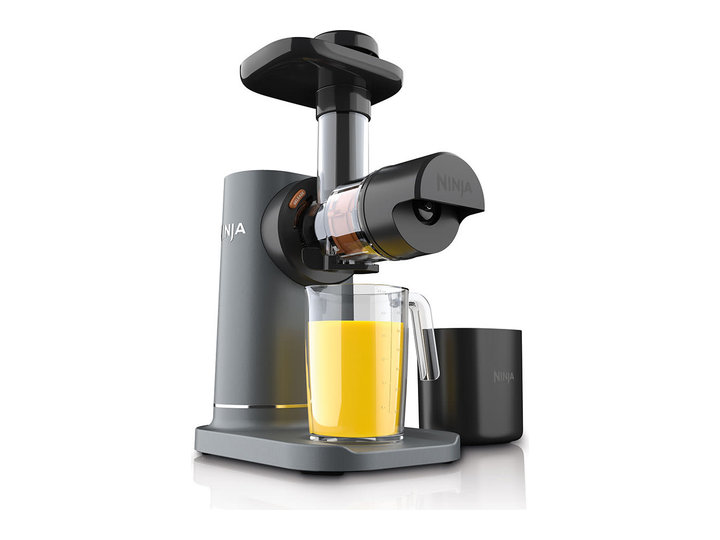
Compact slow juicer, two pulp filters
Ninja NeverClog JC151
Ninja NeverClog Cold Press Juicer JC151
Ninja's small cold press: a 150 W high-torque motor, two interchangeable pulp filters (less pulp or lots of pulp), a reverse button for jams, a 24 oz jug and a 36 oz pulp container. Ninja lists it at under 8 lb with dishwasher-safe juice-contact parts and a one-year warranty.
- Power
- 150 W, 120 V
- Filters
- Two: less pulp, lots of pulp
- Controls
- Start/Stop and Reverse
- Containers
- 24 oz juice jug, 36 oz pulp
- Size
- 12.11 × 7.15 × 15.93 in; 7.94 lb
- Warranty
- 1 year (Ninja); dishwasher-safe parts
Suits: A first slow juicer, an apartment counter, and anyone who wants to choose the pulp level without a strainer swap.
Weigh: Small chute and no hopper, so prep is a knife job; capacity is one or two glasses. Entry-level build.
Foam
Foam is air whipped into the juice. A spinning disc makes a lot of it, which is why centrifugal jugs come with a froth separator, a baffle in the lid that holds the foam back when you pour. A slow auger makes little. Foam is harmless; some people like it.
Oxidation
Juice starts reacting with air the moment it’s made: apple browns, the layers separate, the taste flattens. Fast juicers whip in more air and warm the juice slightly, so it changes sooner. Slow-juicer makers say their juice keeps longer in a sealed container in the fridge (Tribest says up to 72 hours). Whatever the machine, a full, sealed jar with little air in it, cold, is the way to keep juice, and sooner is better.
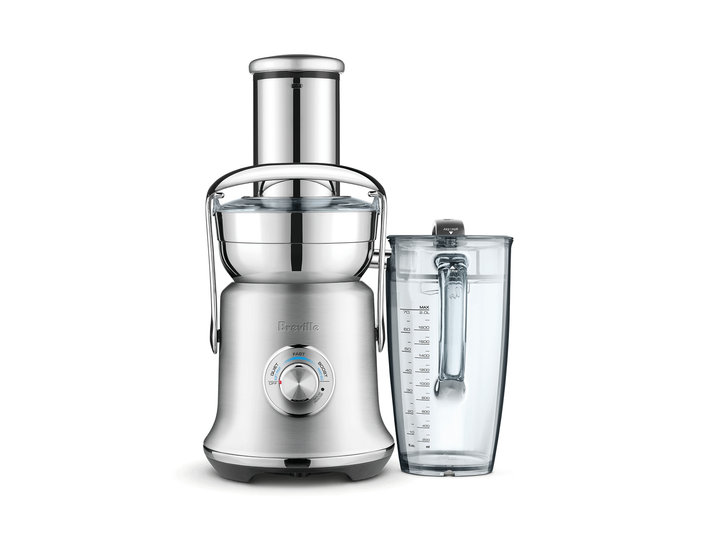
Centrifugal, 3.5 in chute, quiet setting
Breville Juice Fountain Cold XL
Breville BJE830
The big one: a 3.5 in chute, a 1200 W motor, the 70 fl oz jug, and a Quiet setting Breville says cuts mechanical noise by 40 percent. Breville's own line is that it extracts juice up to five times faster than a cold press machine.
- Chute
- 3.5 in, whole fruit
- Power
- 1200 W (listing)
- Noise
- Quiet setting, 40 percent less mechanical noise (Breville)
- Jug
- 70 fl oz
- Size
- 8.7 × 13.39 × 17.44 in; 15.5 lb (listing)
- Filter
- Italian-made precision mesh; Cold Spin
Suits: A household that juices whole bags of produce in one session.
Weigh: The largest and dearest centrifugal here; the same foam and wet pulp as any fast juicer. Hand wash per the listing.
Noise
Noise matters if you plan to juice before the house is up. A centrifugal sounds like a blender; Breville’s Cold XL has a Quiet setting the maker says cuts mechanical noise by 40 percent. Slow juicers hum.
The comparison tables on the cold press and centrifugal pages list speed, chute, strainer and containers for each machine, which is where these differences come from.