Product links on this page go to Amazon. If you buy through them, Upgrade My Juicer earns a commission. How we pick and earn
A fifteen-minute cleanup can make daily juicing hard to keep up. Rinsing the strainer before pulp dries on it makes the next cleanup easier.
The rule
Rinse everything the moment the juice is in the glass, before you drink it. Wet pulp slides off under a tap; dried pulp has to be scrubbed. This is the difference between five minutes and fifteen, on every machine.
The order
- Unplug. Take the jug and the pulp bin away.
- Lift the top off (lid, hopper, chute) and tap the pulp into the bin or compost.
- Pull the auger or disc and the strainer. Rinse each under the tap as it comes off; don’t stack them wet in the sink.
- Brush the mesh (strainer basket or screen) under running water, from the inside out, with the brush the maker put in the box. Thirty seconds, while it’s wet.
- Wipe the base. It never goes in water.
- Leave the parts to dry apart, or put the dishwasher-safe ones in the dishwasher and run it tonight.
What makes it easier
- A dishwasher-safe set. nutribullet’s Juicer and Slow Juicer, the Ninja NeverClog, the Hamilton Beach Big Mouth, Breville’s Compact and the Cuisinart list their removable parts as dishwasher safe. The hopper cold presses (Nama, Hurom, Kuvings) say hand wash, and the parts are big enough that it is quick.
- No mesh. Hurom’s Easy Clean chambers (H400, H70) replace the fine strainer with a two-part auger. There is nothing to brush, and a little more pulp in the glass.
- Fewer parts. Count them on the maker’s page. A twin gear has the most; a hopper vertical has a lid, a hopper, a chamber, an auger, a strainer, a spinning brush and two containers.
- A pulp bin you can carry. Hamilton Beach’s extra-large bin and nutribullet’s lift-off basin go to the sink or the compost in one trip.
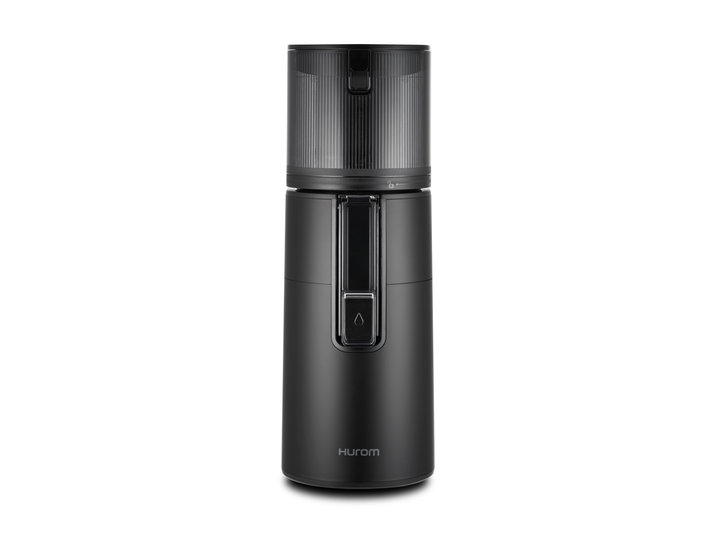
Vertical slow juicer, self-feeding hopper, no mesh strainer
Hurom H400 Easy Clean
Hurom H400 Easy Clean Slow Juicer
Hurom's answer to the J2: the largest self-feeding hopper Hurom has made, a wider inlet you can top up while it runs, and an Easy Clean chamber whose two-part auger strains the juice itself, so there is no fine mesh to scrub. A gauge window shows how full the chamber is.
- Speed
- 150 W motor (listing)
- Feeding
- Self-feeding hopper, Hurom's largest, with an inlet for adding produce while running
- Straining
- Easy Clean chamber: two-part auger, no mesh strainer
- Chamber
- 550 ml (18.6 oz) (listing)
- Size
- 10.3 × 6.6 × 18.5 in (listing)
- Cleaning
- Parts separate; no scrubbing of a mesh; hand wash
Suits: Batch juicing for a household; the person who hates scrubbing a strainer more than anything else about juicing.
Weigh: Easy Clean chambers leave a little more pulp in the glass than a mesh strainer does; Hurom says the H400 has the least pulp of its Easy Clean models, which is not none. Hand wash.
The weekly job
Once a week, soak the strainer in warm water with a spoon of baking soda or a splash of white vinegar for ten minutes, then brush. Mineral and pigment build up in the mesh (carrot and beet stain; it is harmless). Follow the maker’s manual on what the plastics tolerate; the manual is the authority on your machine.
What never goes in the dishwasher
The base, and anything the manual lists as hand wash. Augers and chambers in some machines warp in a hot cycle. If the maker says hand wash, it means it.
For the machines with the shortest cleanup, see the centrifugal page and the cold press page; the cards say what is dishwasher safe and what is not.